Most consultants are still selling an old playbook. You can feel it the moment the process starts.
First comes the discovery call. Then the strategy deck. Then the workshop. Then the internal meeting. Then another meeting to align on what the previous meeting was supposed to decide.
A strategist writes the positioning. A designer translates it visually. A copywriter turns it into words. A developer turns it into a website. A marketer turns it into a campaign. A project manager tries to keep the whole thing from falling apart.
Before ChatGPT, this was normal. It was slow, but it made sense.
Good work needed a lot of people, because every part of the process lived in a different head. Strategy lived with the strategist. Design lived with the designer. Development lived with the developer. Sales logic lived with the founder. Customer knowledge lived somewhere between the inbox, the CRM and the gut feeling of whoever had been there the longest.
So companies built bigger teams around the problem.
More people. More calls. More handovers. More coordination.
And yes, sometimes that worked.
But a lot of the time, it created a strange kind of waste. The client paid for expertise, but also for all the friction between that expertise. Every handover became a chance for context to disappear. Every extra layer made the original idea a little less sharp.
By the time the work reached the customer, the thing that made it interesting in the first place was often watered down.
The client paid for a bigger team, but not always for a better result.
Then AI arrived, and instead of rethinking the full system, many consultants simply replaced the old agency playbook with a slightly newer one.
They moved from the 2018 playbook to the 2022 playbook.
Suddenly everything became about prompts.
The right prompt. The better prompt. The advanced prompt. The prompt library. The workshop that teaches your team how to talk to ChatGPT.
For a moment, that was useful. We all had to learn how to communicate with these tools. I did it too. I wrote the long prompts. I built the frameworks. I explained the role, the audience, the tone, the structure, the constraints and the expected output.
But that phase is already getting old.
Because the bottleneck moved.
The real question is no longer how well you can write one instruction into a chat box.
The real question is how well your business is described before the work even starts.
And that moves the problem into a very different lane.
It moves it into strategy.
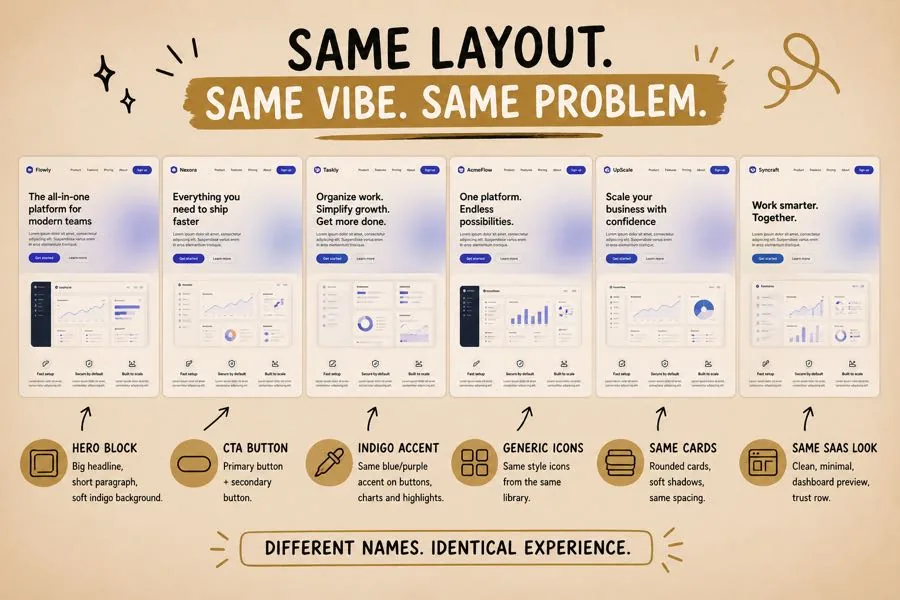
The old model was built around friction
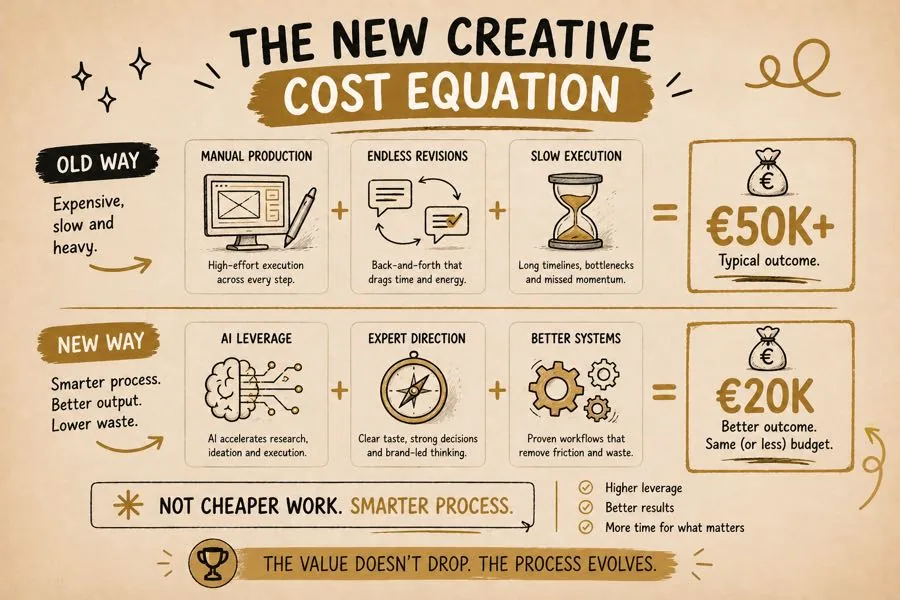
The old agency model was built for a world where execution was expensive.
If you wanted a campaign, you needed a campaign team. If you wanted a website, you needed designers, developers, copywriters and project managers. If you wanted a new product flow, you needed workshops, wireframes, copy decks, technical scoping and weeks of back-and-forth.
The process was heavy because production was heavy.
That also meant a lot of businesses got used to paying for slowness.
Not because anyone was trying to waste time, but because the system itself created delay. A strategist could understand the market, but not always the technical consequences of the idea. A developer could understand the build, but not always the emotional reason behind the experience. A designer could make something beautiful, but not always connect it to sales logic. A marketer could push traffic, but not always fix the offer underneath it.
The founder often had the clearest vision, but that vision had to be translated five times before it became real.
That is where so much money disappeared.
Not only into the work itself, but into the effort of keeping everyone aligned.
AI exposes that.
It does not remove the need for specialists. Good people still matter. Taste still matters. Technical depth still matters. Strategy still matters.
But it does reveal how much of the old process was built around managing friction.
When one person can now move from strategy to copy, from visual direction to prototype, from workflow logic to implementation support, the value shifts.
The biggest team is no longer automatically the strongest team.
The clearest thinking wins.
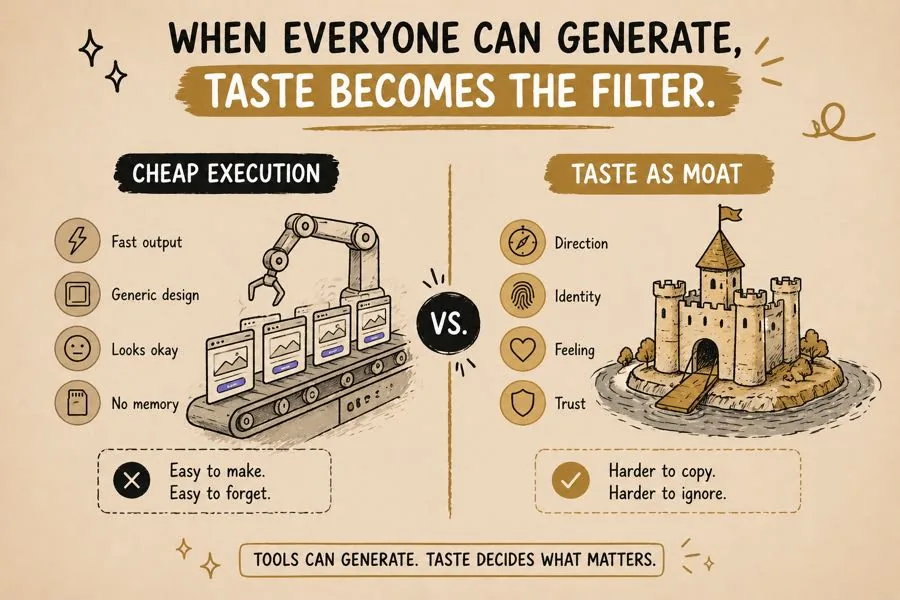
Prompting was only the first phase
Twelve months ago, I was still writing massive prompts.
I would start with something like: “Act as a senior brand strategist.” Then I would explain the business, the audience, the tone, the offer, the market, the structure, the examples, the constraints and the output format.
By the time I was ready to ask the actual question, half the session was already gone.
The model was not the problem. The setup was the problem. Every session started from zero because the context was not ready.
That has changed.
Today, I open Claude, ChatGPT or another tool in my stack, and I do not need to rebuild the whole briefing every time. I work with projects, skills, knowledge layers, saved workflows and internal context files. I can dictate what I want in my own voice, and the system already knows the important parts.
It knows the brand voice, customer profile, tone, offer logic, what kind of output feels right, and what I would probably reject.
That is the real shift.
The bottleneck used to be how well you could write a prompt.
Now the bottleneck is how well you have described your own business.
That is not really a prompt problem.
That is a strategy problem.
And it is exactly the kind of problem brand strategists have been solving for years. We just used different words for it.
We called it brand voice, customer mapping, tone of voice, positioning, messaging architecture, decision principles and operating logic.
Those documents used to end up in a folder after a workshop.
Now they have a second life.
They become infrastructure.
They become the input layer for every intelligent system the business wants to run.
Your business needs a context layer
Most companies do not need more tools.
They already have enough tools.
They have ChatGPT, Claude, Notion, Slack, Google Drive, Make, Zapier, CRMs, dashboards, project management apps and probably three other platforms nobody really uses properly.
The missing piece is not access.
The missing piece is context.
A context layer is the structured knowledge that explains how your business thinks.
It is the difference between a tool that gives you a generic answer and a system that understands what your company is trying to become.
It contains the logic behind your brand, your audience, your offer, your tone, your sales process, your workflows, your internal rules and your quality standards.
It explains what matters, what should never be said, what should be automated and what should stay human.
It turns the things that live in the founder’s head into something the team and the systems can actually use.
That may sound less exciting than a new AI tool.
But it compounds.
A prompt helps once. A context layer improves everything that comes after it.
It improves content because the system understands your voice. It improves sales because it understands your offer. It improves onboarding because new people do not start from zero. It improves automation because workflows are based on real business logic instead of random shortcuts. It improves software because the product is built around how the business actually works.
That is the difference between using AI and building with AI.
One gives you output. The other gives you leverage.
What this looks like in practice
I am seeing this shift directly in the work I am building right now.
For Kinga Cleaning, we are building a time tracker for the team that automatically generates client invoices when a job ends.
That sounds simple, but the value is not just in the timer.
The value is in the business logic behind it.
The system needs to understand the client, the rates, the type of work, the invoicing structure, the follow-up and the way the company wants to communicate. If that context is missing, you only have a tool. If that context is clear, the system starts taking admin out of the business.
The team runs the cleaning work.
The system runs the admin.
That is where automation becomes useful.
The same thing is happening at CWG, where we are building a second brain. Every meeting, every decision, every customer conversation and every important piece of knowledge feeds the same layer.
The goal is not to create another database.
The goal is to create a company that knows what it knows.
When a new employee joins, they should not need six months to understand the full context. When an AI agent gets deployed, it should not start from a blank page. It should land inside a company that already has memory.
That changes how fast a business can move.
Normally, onboarding is expensive because knowledge lives in people’s heads. With AI, onboarding becomes a one-time investment in context. Once the knowledge is structured, the system does not forget.
That is why I keep saying that branding is no longer just communication.
Branding is becoming infrastructure.
The way you describe your company now affects the way your systems work.
Why most consultants have not caught up
A lot of consultants are still focused on the surface.
They talk about prompts, templates, workshops, tool demos and automation tricks.
That is not useless.
But it is not where the deepest leverage is anymore.
Prompt libraries do not compound.
Context does.
A strong brand voice document compounds. A clear customer logic file compounds. A mapped sales process compounds. A written operating system compounds. A proper second brain compounds.
Once those pieces are structured, they become useful everywhere.
They show up in your content. They show up in your sales. They show up in your onboarding. They show up in customer support. They show up in internal workflows. They show up in automations. They show up in the software you build later.
That is why the companies that win in 2026 will not be the companies with the best prompts.
They will be the companies with the best-described businesses.
They will know who they serve, how they make decisions, what they stand for, what should be automated, what should stay human, and how to transfer knowledge into systems.
That is where the advantage is moving.
Into clarity.
Because once your business is clearly described, every tool gets better.
The founder-led problem
This matters even more for founder-led companies.
In most founder-led businesses, the company still lives inside the founder’s head.
The tone, sales logic, customer knowledge, decision-making rules, company explanation and opportunity filter are all in your head.
That works for a while.
It works when the business is small.
It works when everything still passes through you.
But it breaks the moment you want systems, people or AI to help you move faster.
Because they cannot use what has never been translated.
Before a tool can write like you, support like you, sell like you, brief like you or build with you, the business needs to be described properly.
That is the work most people skip.
They want the output before the context.
They want the automation before the logic.
They want the AI agent before the operating system.
And then they wonder why the results feel generic.
The tool is not always the problem. The business is often under-described.
The new work
This is where I believe the real work is now.
Not teaching people a few clever prompts. Not giving companies another dashboard. Not adding AI on top of a messy business and pretending that will fix the structure underneath.
The real work is translating the business into a context layer that people, tools and systems can actually use.
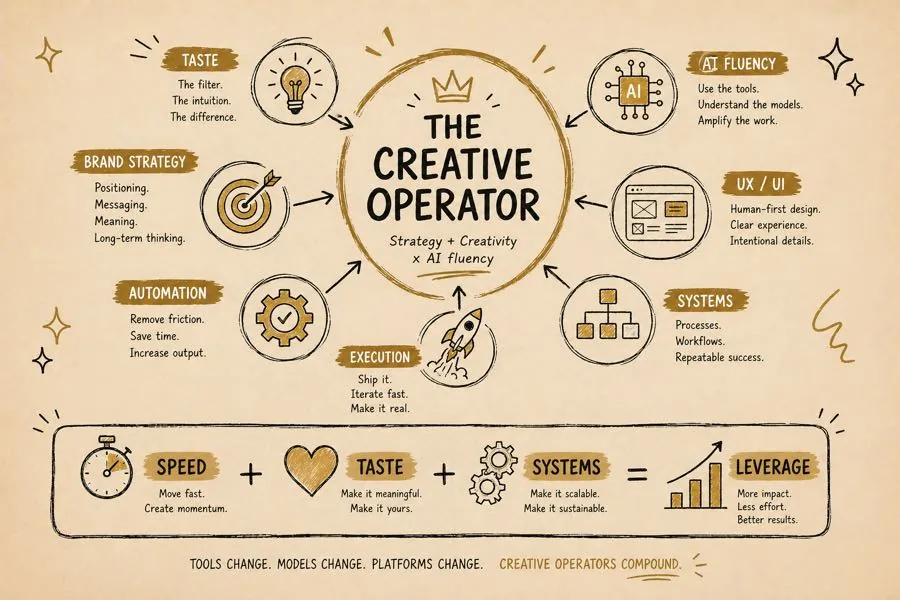
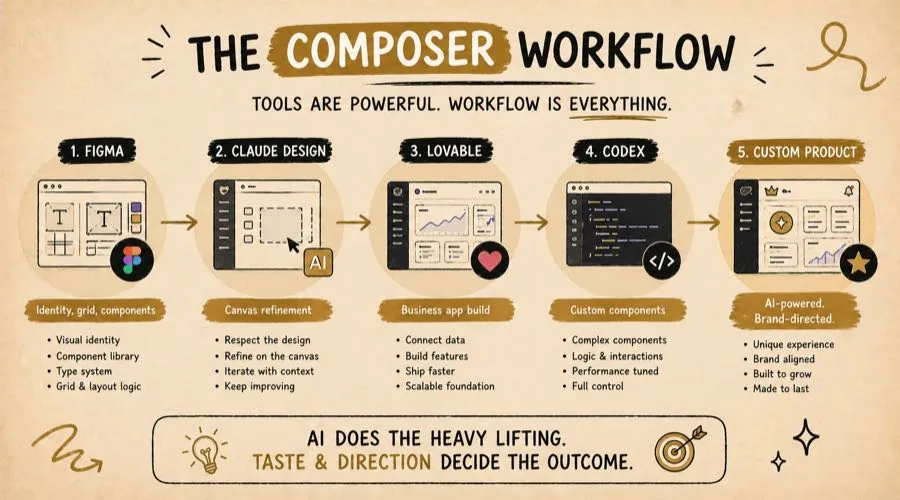
That is part brand strategy, part business analysis, part workflow design and part AI implementation.
It is not the old agency model.
It is not the prompt-bro model either.
It sits somewhere in between.
You need taste, because the output still needs to feel right.
You need strategy, because the system needs to know what matters.
You need technical fluency, because the context has to connect to real tools and workflows.
And you need enough founder empathy to understand that most of the valuable knowledge is not written down yet.
It is hidden in calls, habits, gut feelings, old decisions, repeated explanations and the things everyone in the company “just knows.”
That is the material.
The job is to turn it into infrastructure.
Two ways to start
If you run a founder-led company and you feel that your business is still too dependent on what lives inside your head, I can help you map the first layer.
The first option is a Quick Audit.
For €350, we start with a 30-minute call where I learn how your business works, where the friction is and what you are trying to improve. After that, I do a 60-minute analysis on my side. You receive a clear read on what is missing in your context layer, where AI can actually help, and what I would fix first. The report lands in your inbox the next day.
The second option is a Deep Audit + Roadmap.
For €1,090, we go deeper. It starts with the same call, but expands into a 5-to-7-day review of your positioning, workflows, knowledge structure and AI-readiness. You receive a prioritised roadmap, the context files I would build for your business, and a practical plan for what to load, where to load it, and what should be automated versus what should stay human.
---
Phil Auryon — The Composer.
AI implementation and brand strategy, Belgium.